
Retirement’s Hidden Danger: Why Timing Matters More Than Returns
Recently, I attended a three-day convention in Kolkata for life insurance marketing professionals. I was accompanied by two of my remarkably successful team members, and together we stayed at a hotel near the Salt Lake Stadium. I consider myself fortunate to have had the opportunity during this convention to engage in deep discussions on financial planning and its many aspects with two of my teammates who are highly specialized and well-trained in the field of finance.
On our return journey to Shillong—which took nearly seven hours by flight and car—one of my teammates asked me a thought-provoking question:
“Sir, since you will be retiring from LIC soon, how do you plan to invest your retirement fund? Of course, you will receive a pension, but how will you utilize the commutation amount?”
Being naturally inquisitive, I turned the question back to him:
“Why don’t you suggest how I should plan?” He responded with enthusiasm:
“Sir, I would recommend a wonderful investment idea using the Systematic Withdrawal Plan (SWP) of mutual funds. It comes with relatively lower volatility and the potential for strong growth. I have already advised many retirees, as well as those approaching retirement, to follow this route.”
Curious, I pressed further:
“What withdrawal rate from this SWP would you suggest?”
He advised a rate of 6% to 7%.
As a lifelong student of finance, I have never allowed myself to be biased toward any single investment product. In my view, the true measure of the best product is simple: it is the one that provides the right solution at the right time of life.
Yet, through many personal experiences, one truth has become crystal clear to me—no retirement portfolio can ever be considered complete, safe, or truly wise without the presence of a lifetime guaranteed annuity. Without it, retirement planning carries a risk that is neither desirable nor advisable.
That is why, even after listening carefully to the valuable suggestions shared by my teammates, my inquisitive nature pushed me to delve deeper into this subject. In the following pages, I wish to share some of my research, reflections, and heartfelt prescriptions—drawn not only from theory, but also from the deep conviction that financial security in retirement must rest on the firm foundation of guaranteed income for life.
When it comes to planning income for retirement, there are two very different philosophies:
1) The Probability-Based Approach
This method focuses on investments, mainly in the stock market. The belief is that, over long periods, stocks usually perform better than bonds. Because of this higher return potential, people following this approach feel they can enjoy a better lifestyle in retirement without needing insurance products like guaranteed annuities.
In simple words—they depend on market growth to secure their retirement.
Example:
Mr. A invests his retirement savings mostly in mutual funds. He plans to withdraw money every month from his portfolio, hoping the market will keep giving good returns. When the market does well, he enjoys a higher lifestyle. But if the market crashes or returns are poor, he may have to cut down on expenses—or worse, risk running out of money if he lives too long.
2) The Safety-First Approach
This method is more about security than risk. It says that instead of depending only on the market, retirees should use insurance products like lifetime guaranteed annuities. These products pool risks together.
Here’s how it works: people who pass away earlier leave behind some of their funds, which then support those who live longer. This benefit is called Mortality Credits.
Because of this system, those who live a long life never run out of money. They continue to get income for as long as they live. This not only protects against the risk of living longer than expected but also gives peace of mind, less stress, and a more enjoyable retirement.
Example:
Mr. B takes a part of his retirement savings and buys a lifetime guaranteed annuity. From the very first month, he knows exactly how much income he will receive—for life. He doesn’t have to worry about stock market ups and downs or how long he might live. This steady, guaranteed income allows him to live retirement with confidence, security, and dignity.
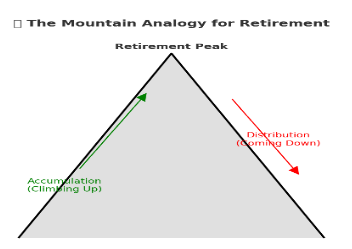
The Mountain Analogy for Retirement
Let us think of our financial life as a mountain climb.
Climbing Up (Accumulation Period):
This is the time when we are working and saving money. Just like a climber steadily moves upward toward the top, we keep putting money into our savings and investments. The goal here is to reach the peak—to build enough wealth for retirement.
Coming Down (Distribution Period):
This is the time when we stop working and start using our savings. Just like descending a mountain, it requires more care and balance than climbing up. The goal is not just to have reached the top, but to come down safely—which means spending your money in a steady, sustainable way so it lasts for our entire lifetime.
Two climbers set out to conquer a mountain.
Climber A rushed to the top quickly, but on the way down he slipped because he had no ropes or support.
Climber B also reached the top, but when descending he used strong ropes, steady steps, and guidance. He reached the ground safely and happily.
Retirement works the same way. Accumulating wealth is important—but distributing it wisely is even more important. Without a safety system (like guaranteed income or annuity), the “descent” can be risky. With proper planning, the descent is safe, peaceful, and enjoyable.
16 Golden Lessons for Retirement Income Planning
Retirement is not just about reaching the top of the mountain of wealth—it is about coming down safely, steadily, and joyfully. These lessons remind us how to prepare wisely for a secure and fulfilling retired life.
1. Safety-first with annuity = certainty.
Choosing a guaranteed annuity plan ensures a fixed income for life and leaves behind a clear legacy.
2. Annuity protects income, frees other assets.
Since annuity takes care of our monthly income, our other savings can be used for growth or future needs.
3. Mortality credits = bigger legacy.
If we live longer, mortality credits from annuities give us more income and can help our legacy last longer.
4. Investments alone can’t guarantee lifelong income.
In market-based (probability) planning, there’s no guarantee that our savings will last our entire life.
5. Risk of reverse legacy.
If investments fail and savings run out, retirees may end up depending on their children or others for financial support.
6. Retirees live longer today.
Modern retirees will spend more years in retirement compared to earlier generations.
7. Less risk capacity in retirement.
As people enter retirement, their ability to take financial risks becomes lower.
8. No steady income = more vulnerable.
Since retirees can’t easily earn money again, market ups and downs can force them to cut down their lifestyle. A market-based (probability) plan can easily fail.
9. Pre-retirement focus is incomplete.
Many people plan for wealth growth before retirement but ignore two big dangers after retirement:
Longevity risk (living longer than expected) Market risk (bad returns at the wrong time) Investment managers often dismiss these risks, assuming the stock market will eventually do well—but that’s not always true for retirees.
10. Early market losses hurt more.
If the market falls in the first few years of retirement, it can badly affect how long our money will last.
11. NPS is not a full pension.
Unlike traditional pensions, NPS puts more risk and responsibility on employees instead of employers.
12. Plan to live, not to die.
A good retirement plan should focus on enjoying a long life, not just preparing for the end.
13. Don’t leave money on the table.
The goal is retirement efficiency—choosing strategies that give us higher lifetime income and a better legacy. If one method lets us spend more and still leave more behind, it’s the smarter choice.
14. Keep expectations realistic.
Don’t assume very high returns from investments—half the time, actual returns may turn out lower than expected.
15. Avoid over-optimistic plans.
Be cautious of retirement plans that only work if returns are very high; they may fail when markets are weak.
16. Retirement is for living.
Sadly, some retirees never spend on things that bring them joy. Retirement should be about enjoyment as well as security. Based on the above points, I strongly recommend and advocate that retirement planning should be built on the safety-first approach.
Why? Because people today are living longer than ever before. On average, a 60-year-old male can expect to live until age 80, while a 60-year-old female can expect to live until age 84.
But here is the problem with averages:
Half of all 60-year-old males will pass away before 80, but the other half will live beyond it.
Similarly, half of all 60-year-old females will pass away before 84, but the other half will live longer.
This means we cannot plan retirement income based only on averages. In reality, we need to prepare for the possibility of living until age 100—or even longer.
Our retirement savings may need to support us for 30 years or more. This is the greatest challenge in retirement—Longevity Risk. And longevity is not just a risk in itself, but a risk multiplier—because the longer we live, the greater the chances that other risks (like market risk, inflation risk, and health care expenses) will also come into play.
So, if you ask me what the biggest risk in retirement is, I would say without hesitation that it is longevity risk. Why? Because longevity risk has a multiplier effect on all other risks, such as:
1. Withdrawal rate risk
2. Sequence of return (order of return) risk
3. Inflation risk
4. Deflation risk
In this article, I will focus specifically on sequence of return risk.
In the early 1990s, William Bengen, a financial planner in the United States, introduced the concept of the Sequence of Returns Risk.
Definition:
Sequence of Returns Risk is the danger that the order in which investment returns occur—especially early in retirement—can dramatically affect how long our savings last. Even if the average return is the same over time, poor returns in the early years combined with regular withdrawals can cause a portfolio to deplete much faster than expected.
As we discussed, longevity risk multiplies all other risks in retirement. One of the most dangerous among them is the Sequence of Returns Risk.
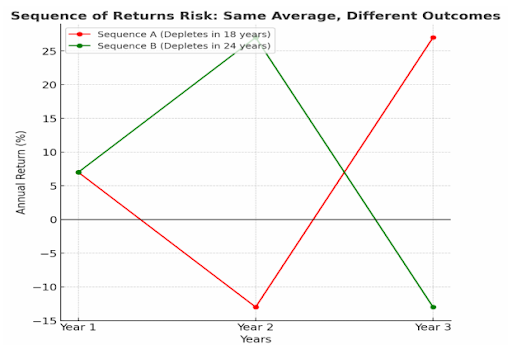
A study by the Government Accountability Office (June 2011) of U.S.A discussed the order of returns risk and provided the following example based on $100,000 initial investment at age 65 and assumes a 9% annual withdrawal rate. It also projected that the returns below would repeat every three years. The report noted that “if the sequence of returns in the second and third year were reversed, holding all else constant, the average annual return would be the same; yet if withdrawal is made each year, savings will be depleted sooner with the first sequence of returns.”
Red Line (Sequence A): Early losses cause the portfolio to run out in 18 years. Green Line (Sequence B): Early gains make the portfolio last 24 years.
Both have the same average return (7%), yet outcomes are very different.
This simple picture makes the Sequence of Returns Risk easy to understand: It’s not just how much we earn, but when we earn it that matters in retirement.
The lesson is simple: It’s not only the average return that matters, but the order in which returns occur.
This risk is especially dangerous when using Systematic Withdrawal Plans (SWPs) from mutual funds, because regular withdrawals during a market downturn can accelerate the depletion of savings.
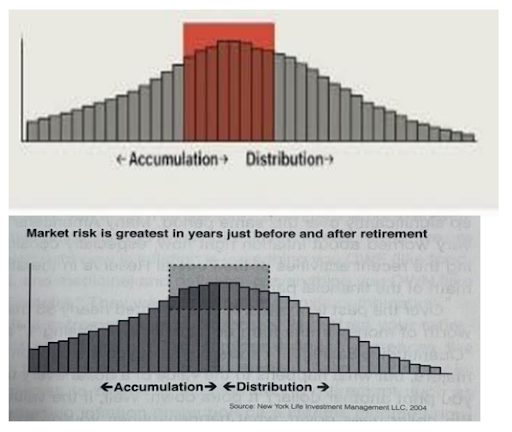
Entering the Retirement Red Zone: Why Timing Matters More Than We Think
When we talk about retirement planning, the focus is often on how much wealth we have accumulated. But what matters even more is when we face gains or losses in the market.
The years just before and after retirement—often called the Retirement Red Zone—are the most fragile stage of our financial journey. This 10–12-year window can either secure our retirement dreams or put them at serious risk.
Imagine retiring in 2008 during the global financial crisis, or in the uncertain early months of Covid-19. If market losses strike at the very moment we begin to withdraw money, the impact can be devastating. Withdrawals from a shrinking portfolio not only reduce today’s balance but also cripple future compounding—causing our savings to run out much earlier than expected.
This is exactly what we call the Sequence of Returns Risk. And it is far more dangerous than many people realize.
The real risk is not our age—it is the timing of returns. Losses at age 75 may hurt, but losses at age 60, just as retirement begins, can permanently alter the course of our financial future.
Why Timing of Losses Matters So Much
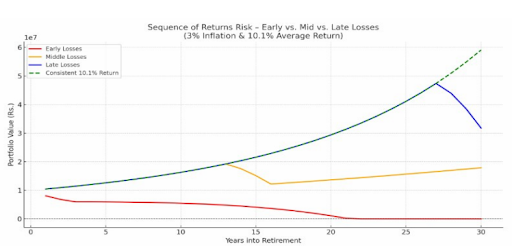
The chart below makes the lesson crystal clear. All four retirees had the same average return of 10.1% and faced the same inflation rate of 3%. But because the timing of market losses was different, their retirement outcomes were dramatically different:
Red Line – Early Losses (Years 1–3): The portfolio depleted the fastest.
Orange Line – Mid-Term Losses (Years 14–16): The impact was noticeable but not fatal.
Blue Line – Late Losses (Years 28–30): A drastic impact, but by then the retiree had already enjoyed many years of income.
Green Line – Smooth Returns: The ideal scenario—consistent growth and stability.
Key Insight: Even when long-term returns are identical on paper, early market losses can destroy a retirement plan. This is the very heart of the Sequence of Returns Risk
That is why I always advocate creating a base of passive and guaranteed income to cover at least our minimum essential needs in retirement. This safety-first foundation ensures that no matter how markets behave, or how long we live, our dignity and basic lifestyle remain protected.
Retirement is not only about how much wealth we accumulate, but also about how wisely we distribute it and how securely we sustain it. By acknowledging risks like longevity and the sequence of returns, and by anchoring our plan on guaranteed income, we can enjoy peace of mind and a more fulfilling retired life.
In the days ahead, I will share more about withdrawal rate risk and other retirement challenges that are deeply connected with longevity risk. Each of these risks must be understood and addressed if we truly wish to make retirement not just a long life, but a good life.
( Source- New York Life Investment Management LLC, 2004, Paychecks and Playchecks)
Financial Business Continuity Planner | LIFEPLUS Office, Shillong