
Retirement is not an end — it’s a sacred transition from earning to meaning. It is when life asks: “Have you merely lived long, or have you lived well?” Just as the Vedas describe the four stages of life — Brahmacharya (learning), Grihastha “धनंमूलंसर्वेष ंसुख न म्” Dhanam moolam sarveshām sukhānām (Food • Clothing • Housing • Transportation • Insurance • Taxes) Funding: Small emergency corpus for medical and maintenance needs “सुरक्ष एर्व श न्तः क रणम्” (Travel • Hobbies • Entertainment • Gifts) It’s the time to see the Himalayas, to feed the birds, to give sweets to grandchildren, to attend weddings without calculating cost — to live, not merely exist. This is the ‘Karmaphal Bhoga’ stage — reaping the fruits of what we sowed with sacrifice. Funding: The purpose here is not extravagance but emotional fulfillment — the joy of daan, sneh, and sangati (giving, love, and togetherness). “त्य गतनैकत अमृतत्वम नशुः ” — Isha Upanishad (Heirs • Charities) Funding: In this stage, we become custodians of continuity. “अयम त्तनजः परो र्वतत्तत गणन लघुचततस म्। A meaningful retirement is not about withdrawal — it’s about awakening. It’s about turning wealth into wellbeing, earnings into empowerment, and insurance into assurance that our family and our values will live on. “धमेण धनंप्र प्यतत, धन त्सुखं, सुख त्श न्न्ः ।” So, when we plan for retirement, let us remember — Let me explain the scientific way to recommend a retirement planning to our revered clients and prospectsThe E.A.S.E. Process (Envision–Analyze–Solutions–Evaluate) is indeed one of the most elegant frameworks for holistic financial and retirement planning. It aligns perfectly with the values we often share — dignity, freedom, and confidence. Let’s explore each step deeply, both rationally and emotionally, with relatable examples that resonate with Indian retirees and families. “A goal without a vision is just a wish.” Objective: Ask questions like: Example: Thought: “Numbers tell the story — but understanding tells the truth.” Objective: Example: So, analysis converts vague fears into clear facts — the first step to empowerment. Insight: “Strategy is the art of turning vision into reality.” Once we understand the client’s goals and gaps, we should design customized solutions — a blend of safety, liquidity, and growth. Objective: Possible Solutions for Retirement: Example: Thought: “A plan is only as good as its review.” Objective: Evaluate every year: Example: This stage is where advisors become lifelong partners — not product sellers, but guardians of peace. Wisdom: The Essence of the E.A.S.E. Process “श न्न्ः प्र प्त न त्तर्वितन, श न्न्ः प्र प्त त्तर्वर्वतकतः ।” Final Reflection: “श न्न्ः प्र प्त न त्तर्वितन, श न्न्ः प्र प्त त्तर्वर्वतकतः ।” The Retirement Income Matrix – A Journey from Survival to Significance
(duty), Vanaprastha (detachment), and Sannyasa (liberation) — retirement marks our
passage into Vanaprastha, where wealth must serve peace, purpose, and posterity.
“Wealth is the root of all forms of happiness — but only when used with wisdom.” 1. CORE EXPENSES – The Foundation of Peace (आत्मरक्ष धममः)
These are the necessities that uphold dignity.
Just as a tree draws nourishment from its roots, one’s retired life draws stability from guaranteed income — income that flows even when one cannot work.
Purpose: To protect oneself from dependence, fear, or compromise.
This stage represents “Sthirata” — stability.
When the foundation is firm, peace blossoms naturally.
Surakṣā eva śānteḥ kāraṇam
“Security is the cause of peace.” 2. JOY EXPENSES – The Blossoming of Life (जीर्वनतआनन्दः)
After a lifetime of duties, this stage is reward, not indulgence.
“Through the spirit of giving, one attains immortality.”
When joy flows freely, gratitude multiplies. 3. LEGACY – The Continuity of Values (संपत्ति सतसंस्क र तक)
The final stage of wealth is not possession — it is transmission.
Legacy is not what we leave for people, but what we leave within them.
It is the living proof that we did not just earn money — we earned blessings.
Just as the Ganga flows from the Himalayas nourishing generations unseen, one’s legacy flows beyond death — a stream of love, values, and responsibility.
उद रचररत न ंतुर्वसुधैर्व कु टुम्बकम्॥”
Mahopanishad
“For the noble-hearted, the whole world is one family.”
This is the spirit of legacy — extending care beyond the self.
The Philosophy Behind the Pyramid
Layer Essence Purpose Emotional Truth
Core Stability To protect life’s dignity Peace through predictability
Joy Celebration To honour life’s journey Happiness through gratitude
Legacy Continuity To nurture life beyond self Immortality through love
“Through righteousness comes wealth, through wealth comes happiness, through happiness comes peace.”
“Build income not just for living, but for loving, giving, and leaving behind light.”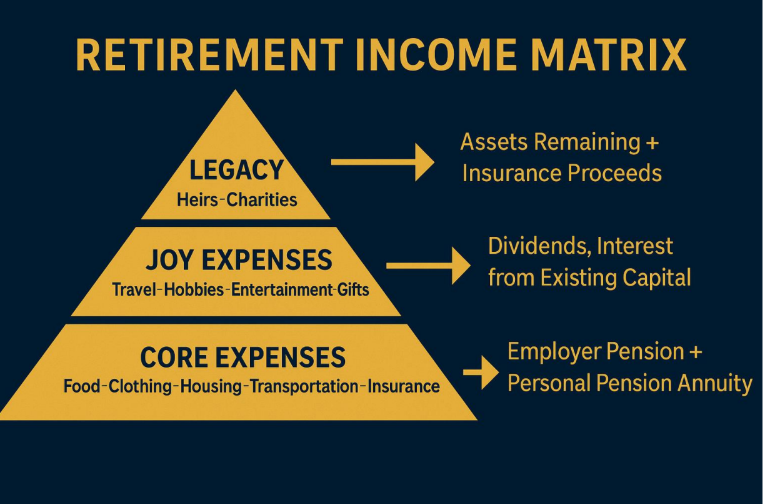
Step 1: ENVISION — See the Life Before We See the Numbers
Before we talk about money, we must talk about life — because money is only meaningful when it serves life’s purpose.
Help clients envision their ideal retired life. Not as an end, but as a new chapter of contribution, reflection, and joy.
“How do you want your typical day to look after retirement?”
“Who are the people you want to spend time with?”
“What gives you a sense of meaning and joy — travel, service, spirituality, or family gatherings?”
Mr. and Mrs. Ghosh, aged 55, said they want to travel on pilgrimages twice a year, maintain a small garden, and contribute to an orphanage. Their vision isn’t just income — it’s independence with purpose.
So, at this stage, you help them paint the picture — because when vision is clear, decisions become simpler.
“यथ दृत्ति तथ सृत्ति।”
Yathā dṛṣṭi tathā sṛṣṭi — “As the vision, so is the creation.” Step 2: ANALYZE — Understanding Reality with Empathy
Now that we know what life they want, we examine where they are today.
Analyze their current resources, future liabilities, and risk appetite. This includes:
Income streams (salary, pension, rental, business)
Expenses (core, joy, and legacy, as you beautifully framed before)
Assets and liabilities
Insurance and protection coverage
Taxation impact and inflation sensitivity
You find that Mr. Ghosh’s savings are mostly in real estate and FDs — FDs highly illiquid and
both are inflation-sensitive. Their current portfolio may not sustain 25 years of retirement
without erosion.
Through analysis, you reveal hidden risks like:
“ज्ञ नंबन्धनमोक्ष य।”
Jñānam bandhanamokṣāya — “Knowledge is what frees us from bondage.” Step 3: SOLUTIONS — Building the Bridge Between Dream and Reality
To craft a financial architecture that ensures lifetime income, peace, and legacy.
You advise Mr. & Mrs. Ghosh to:
Convert a portion of their FD corpus into an annuity plan for guaranteed lifetime income.
Keep an emergency fund equal to 12 months’ expenses.
Buy a health plan with critical illness coverage.
Create a legacy corpus through whole life insurance to support their generations, charity or chosen orphanage.
This stage gives them confidence and clarity. They start seeing their financial plan as a reflection of their values — not just numbers.
“कममण्यतर्व त्तधक रस्ततम फलतषुकद चन।”
Karmanyeva adhikaraste mā phaleṣu kadācana — “Focus on the right actions; the results will follow.” Step 4: EVALUATE — Continuous Care, Not One-time Advice
Life changes. Goals evolve. Markets shift. The client’s mindset matures. Hence, the financial plan must breathe and adapt.
To review progress regularly, refine strategies, and realign with changing needs.
After two years, the Ghoshes’ son settles abroad. Now, they decide to reduce property holdings and increase annuity and philanthropic funds. Their plan evolves from security to significance.
“पररर्वतमनंप्रकृ ततः धममः ।”
Parivartanam prakṛteḥ dharmaḥ — “Change is the law of nature.”
Peace is not achieved by wealth, but by wisdom in using it.
Step Action Outcome Emotion
Envision Define the life you want Purpose Inspiration
Analyze Understand where you stand Awareness Clarity
Solutions Bridge the gap Structure Confidence
Evaluate Evolve with time Adaptability Assurance
A great retirement plan does not end with a cheque — it begins with a conversation about life.
And the E.A.S.E. process is that sacred dialogue between dream and discipline, emotion and economics**, freedom and foresight.
Peace is not achieved by wealth, but by wisdom in using it.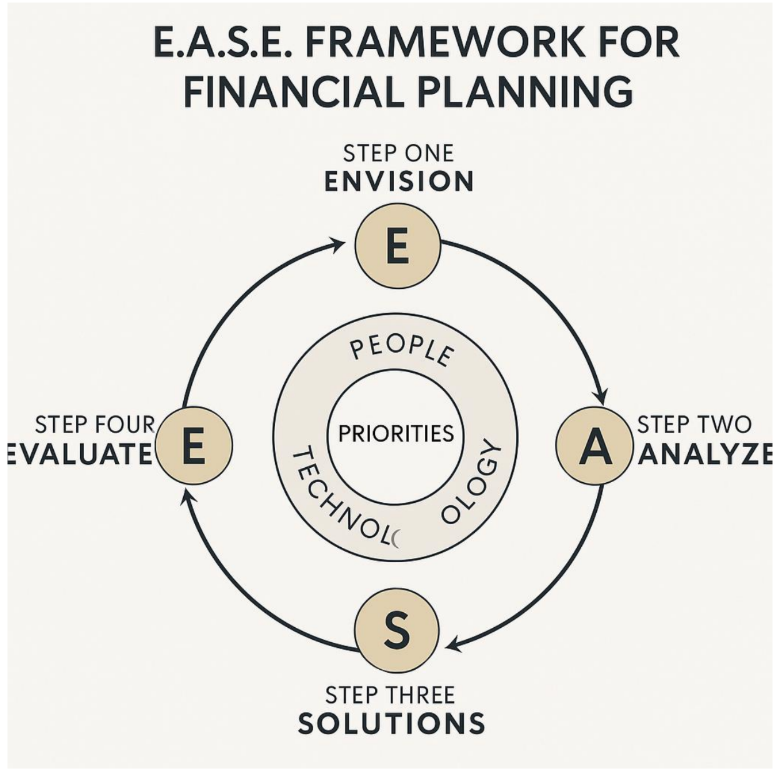
Masters in Economics
MCAFP, QPFPA, Go-Past, Chennai
Editor- Life A Promise
Nayan Bhowmick