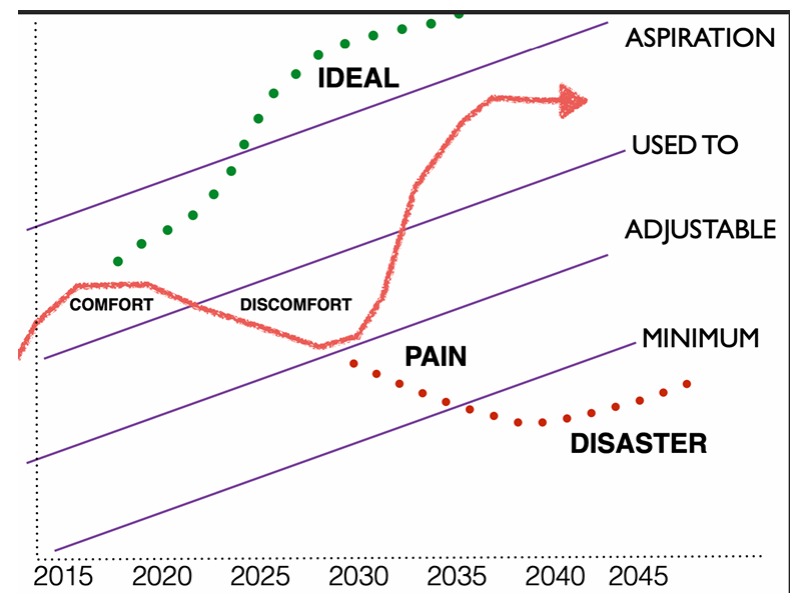
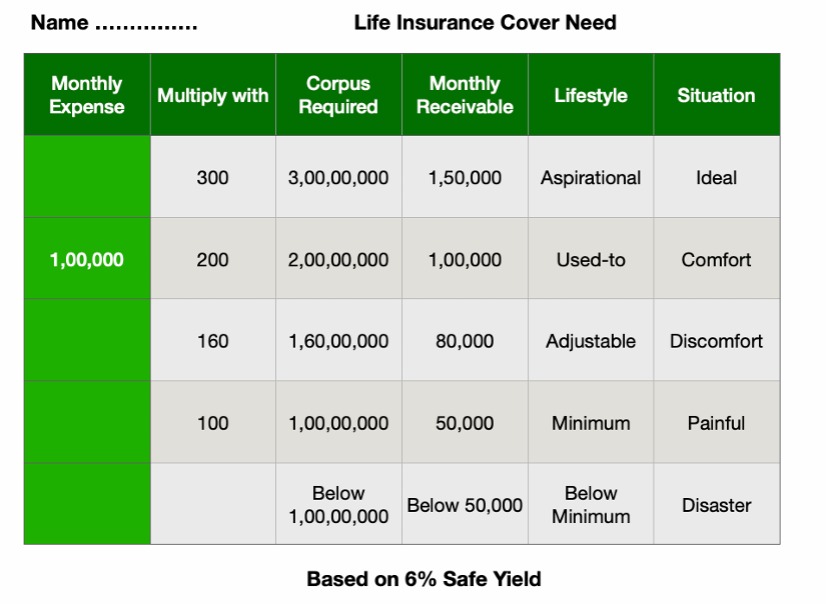
Every family becomes accustomed to a certain way of life. The home it lives in, the education its children receive, its everyday comforts, and its financial commitments gradually form a familiar pattern. Maintaining this pattern requires a certain amount of money every month. The amount differs from one family to another. One family may need ₹50,000 a month, another ₹1 lakh, and another ₹5 lakh. Although the amounts vary, we can understand a family’s lifestyle through four distinct levels: used-to, adjustable, minimum, and aspirational. These four levels help us understand how changes in income can affect a family’s way of life. The used-to level is the lifestyle a family currently enjoys and has become accustomed to maintaining. Suppose my family requires ₹1 lakh a month to meet its usual expenses and maintain its present way of life. This amount represents our used-to level. For another family, the corresponding amount may be ₹50,000 or ₹5 lakh a month. The defining feature is the lifestyle the family has become accustomed to and the amount required to sustain it. Now, let us assume that my family’s income falls for some reason. Although we are accustomed to spending ₹1 lakh a month, we may be able to manage with ₹80,000 by reducing some expenses and making adjustments. There will certainly be difficulties, but the family can still manage. This is the adjustable level: a lower level of expenditure at which the family can continue its life by accepting some sacrifices. If the family’s income falls further, there comes a point below which even essential commitments become difficult to meet. In our example, let us assume that the family needs at least ₹50,000 a month to pay school fees, EMIs, and other basic expenses. This is its minimum level. Thus, while ₹1 lakh supports the lifestyle we are accustomed to, and ₹80,000 allows us to adjust, ₹50,000 represents the minimum amount required to meet our essential commitments. We work hard because we want to improve our lives and provide more for our families. We hope that a growing income will allow us to enjoy a better lifestyle than the one we currently maintain. This desired way of life is the aspirational level. It represents the lifestyle we hope to achieve as our income grows beyond the amount needed for our present comforts. The lifestyle my family maintains today is supported by the income we currently earn. Yet income can rise or fall. When we meet customers, many naturally expect their income to continue growing. A customer earning ₹2 lakh a month today may hope to earn ₹5 lakh a month in the coming years. As financial advisors, we also wish to see our customers prosper. If their income grows as expected, we should celebrate their success. At the same time, understanding the possibility of a decline in income is essential. A change in income can move a family from one financial situation to another, affecting its comforts, commitments, and aspirations. The relationship between a family’s income and its four lifestyle levels creates five possible financial situations. When income rises beyond the aspirational level, the family is in an ideal situation. It has the means to support the life it hopes to enjoy. Every family would naturally wish to reach this position. When income is above the used-to level but below the aspirational level, the family is in a comfortable situation. Its familiar lifestyle is supported, even though all its aspirations may not yet be fulfilled. When income falls below the used-to level but remains above the adjustable level, the family experiences discomfort. It must reduce some expenses and give up certain comforts. Life remains manageable, but the changes are felt. When income falls below the adjustable level but remains at or above the minimum level, the family enters a painful situation. The adjustments become more demanding, and the family must make substantial sacrifices while protecting its essential commitments. If income falls below the minimum level, even essential commitments become difficult to meet. Within this framework, this is the disaster situation. The four lifestyle levels therefore help us understand how a family may move through ideal, comfort, discomfort, pain, and disaster, depending on the income available to it. Let me explain it with the following figure. This figure was designed and created by our most revered Sir, Sir Gopinath. The four upward-sloping lines represent these lifestyle levels: aspirational, used-to, adjustable, and minimum. Their rise over time illustrates how the financial requirements associated with each level can increase as the years pass. Against these lines, the coloured paths illustrate different possible income journeys. Income may grow, decline, or recover after a difficult period. As it moves in relation to the four lifestyle levels, the family’s financial situation changes. When income rises above the aspirational level, the family enjoys an ideal situation. Between the aspirational and used-to levels, it experiences comfort. Below the used-to level, but above the adjustable level, it faces discomfort. Between the adjustable and minimum levels, it experiences pain. Below the minimum level, it faces disaster. The rising green dots illustrate a journey towards the ideal situation. The descending red dots illustrate how falling income can move a family through pain and into disaster. The continuous red path shows another possibility: a period of comfort, followed by discomfort, and then a recovery towards a better financial position. These are illustrative possibilities, rather than predictions. They remind us that a family’s income may change while its financial commitments continue. If the income supporting our way of life were reduced or lost, how would our family continue? The main reasons for the stoppage of income are: The illustration titled “Life Insurance Cover Need” takes this discussion a step further. It connects a family’s monthly financial requirements with the capital needed to generate an equivalent income. The central question is: If the earning member’s income stops, how much capital would the family need to support its way of life? Let us continue with the example of a family whose current monthly expenses are ₹1 lakh. The illustration assumes an annual yield of 6%, with the income available for spending and the The principal remaining intact. Under this assumption, every ₹1 crore generates ₹6 lakh a year—equivalent to ₹50,000 a month. The figures illustrate the four lifestyle levels as follows. The table presents representative amounts at each lifestyle level. The five situations described earlier explain what happens as income moves between these levels or falls below the minimum. At the assumed annual yield of 6%, a corpus of ₹3 crore generates ₹18 lakh a year, equivalent to ₹1.5 lakh a month. This supports a lifestyle above the family’s present level and represents the ideal situation shown in the illustration. A corpus of ₹2 crore generates an assumed annual income of ₹12 lakh, equivalent to ₹1 lakh a month. This amount supports the family’s familiar expenses and allows it to maintain the lifestyle it has become accustomed to. A corpus of ₹1.60 crore generates an assumed annual income of ₹9.60 lakh, equivalent to ₹80,000 a month. Compared with the family’s usual monthly expenses of ₹1 lakh, this creates a shortfall of ₹20,000. The family must make adjustments and reduce some spending. A corpus of ₹1 crore generates an assumed annual income of ₹6 lakh, equivalent to ₹50,000 a month. In this example, that is the minimum amount needed to meet essential commitments. The family can meet these commitments only by accepting substantial sacrifices. If the available income falls below ₹50,000 a month, the family moves below its minimum level and into the disaster situation described in this framework. The illustration uses the family’s current monthly expense of ₹1 lakh as the base: At an assumed annual yield of 6%, the general calculation is: Required Corpus = Annual Income Required ÷ Assumed Annual Yield The different multipliers in the illustration arise because each corpus is expressed in relation to the same current monthly expense of ₹1 lakh, while the desired monthly income differs at each lifestyle level. Understanding these levels brings the conversation closer to the family’s actual life. We, as advisors, need to understand the lifestyle the family currently enjoys, the adjustments it could reasonably make, the minimum amount required for essential commitments, and the aspirations it hopes to fulfil. These questions give meaning to the discussion about financial protection: A sound financial plan should support the family’s aspirations while helping it protect its accustomed lifestyle and essential commitments. Every insurance amount represents something meaningful in a family’s life: a child’s education, a home, a financial commitment, or the ability to continue with dignity. Behind every insurance amount is a family’s way of life. Adequate protection helps that family continue with dignity when the income it depends on is lost. The calculations assume a constant 6% annual yield before tax, with the principal remaining intact and no allowance for inflation. The slide’s phrase “6% Safe Yield” represents an illustrative assumption, not a guarantee. These corpus figures illustrate income replacement; they are not a complete calculation of an individual family’s life insurance needs.
“Through experience and toil the human life may be constantly growing more valuable, the dependent family in the meantime becoming more and more accustomed to a higher standard of living and suddenly the entire value may be swept away by death. Unless some substitute—some sort of Hedge—can be found, there will be nothing to take the place of the economic value of the deceased.” — Prof. S. S. Huebner
Protecting Income, Preserving a Family’s Way of Life
Four Levels of Lifestyle and Five Financial Situations
The Four Levels of Lifestyle
1. The Used-to Level: The Life We Have Become Accustomed To
2. The Adjustable Level: The Life We Can Manage with Some Changes
3. The Minimum Level: The Amount Needed for Essential Commitments
4. The Aspirational Level: The Life We Hope to Achieve
Our Income Can Rise—and It Can Fall
The Five Financial Situations
1. Ideal
2. Comfort
3. Discomfort
4. Pain
5. Disaster
Understanding the Figure
Connecting Lifestyle with Life Insurance Cover
₹3 Crore: Supporting the Aspirational Lifestyle
₹2 Crore: Maintaining the Used-to Lifestyle
₹1.60 Crore: Supporting the Adjustable Lifestyle
₹1 Crore: Supporting the Minimum Lifestyle
Understanding the Multipliers
Connecting Financial Protection with a Family’s Lifestyle
Important Assumptions
A Thought-Provoking Perspective on Life Insurance