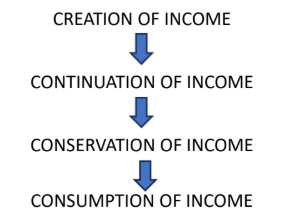
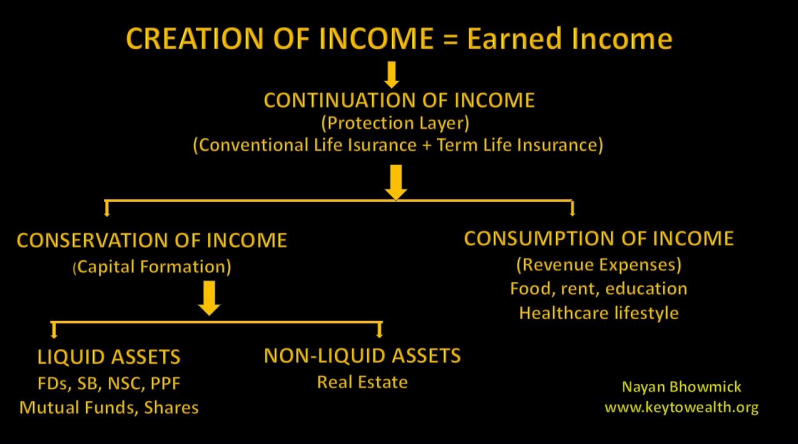
A Scientific Approach to Life, Income and Dignity In the journey of life, every family stands upon a silent yet powerful foundation — its economy. Not the economy of markets, not the economy of nations, but the economy of survival, dignity, and continuity. A family does not live on money alone. It lives on income, security, discipline, and purpose. From the moment a family begins its journey, a natural financial cycle unfolds — often unnoticed, yet deeply impactful. This cycle determines whether a family will merely survive or truly thrive. This is what we call: The Family Welfare Economics A simple, yet profound framework that explains how every family’s financial life moves through 4 (four) essential stages: 1. Creation of Income – This is the first and most fundamental step of a family economy. In Economic terms, this is called “Human Capital”. This income supports Without Creation of Income, no family economy can exist. But there is one important truth: Income Creation is dependent on the life, health and working ability of the breadwinner. Therefore, it is uncertain and fragile. 2. Continuation of Income: – This is the most critical stage in family financial planning. A family does not need income only today. A family needs income every month for many years. But what happens if the income earner dies or becomes disabled or critically ill? The Creation of Income suddenly stops. But the family expenses continue, these creates financial disaster for the family. This is why the Continuation of Income becomes extremely important. 3. Conservation of Income: – The third stage is Conservation of Income. This means protecting and growing the income through savings and investments. “Capitals are increased by parsimony and diminished by prodigality and increased by parsimony…” Parsimony means wise saving and disciplined spending. “…diminished by prodigality and misconduct” Wealth gets destroyed by overspending, luxury without purpose, and wrong financial decisions “When a person saves from his revenue, he adds to his capital” Income alone does not create wealth Only saving from income converts income into capital Why Conservation Comes Third? Income is first created. Then it must be protected (continued) — because without continuity, nothing else matters. Only after protection, we focus on: If income stops → no saving possible If income continues but is not conserved → no wealth creation The Core Principle is: Traditional Thinking INCOME – EXPENDITURE = SAVINGS is WRONG and This is what most people follow, Result: Savings become residual (whatever is left, often nothing). Correct Wealth Principle is INCOME – SAVINGS = EXPENDITURE. This is a game-changing philosophy. Here, saving becomes a priority, not an afterthought, and expenses are adjusted after securing the future. Examples of savings and investments: Conservation of income ensures: Without conservation, families remain financially vulnerable in old age. A family does not become wealthy by earning more, but by saving wisely from what it earns. Wealth is not created by income alone; it is created by the discipline of conserving income. And that discipline begins when we change the formula from INCOME – EXPENDITURE = SAVINGS to INCOME – SAVINGS = EXPENDITURE.” 4) Consumption of Income: Once income is created, protected and conserved, Consuming includes: Why Consumption Comes Last: Ancient Indian households followed: Earn → Protect → Save → Then Spend. From Adam Smith to Chanakya, from Thirukkural to our mothers’ kitchens — the message is the same: A wise family does not consume first; it protects and preserves first. Because consumption satisfies today, but conservation secures tomorrow. At this stage, it becomes important to understand why Continuation of Income holds the second position—before Conservation and Consumption. To establish this clearly, let us explore the 4(four) possible scenarios of life and income. Human life moves through many uncertainties. Every family depends on income, but income does not always continue as long as life continues. When we observe life carefully, we can broadly see four possible situations regarding life and income. Scenario 1: Life and Income Continue Together Examples: In this case, family expenses are well managed, children are educated and established, and retirement life is comfortable. This is the ideal situation, but in reality, it is very rare. Most people eventually stop earning due to retirement, health issues, and age. Therefore, income rarely continues as long as life. Scenario 2: Life Continues but Income Stops Scenario 3: Premature Death of the Breadwinner Example: The income stops, but family responsibilities continue. Scenario 4: Very Early Stop of Income If income disappears suddenly, the family may face poverty, financial struggle, and emotional trauma. Life may be uncertain, but income must not be. Because income is not just money—it is the continuity of dreams, dignity, and life itself.A family does not run on emotions alone—it runs on income. It is income that educates children, cares for loved ones, and protects dignity. In every possible situation of life, income remains the most essential force. Hence, ensuring its continuation is not just financial planning—it is a responsibility towards the dreams we hold and the lives we love. Recently, at a convention at Kolkata, our respected mentor Sir Gopinath beautifully explained the four possible scenarios of life and income. At the end of the session, he encouraged me to carry this message forward—to share it with my agents, colleagues, and the wider society.On various occasions and platforms, I have tried to follow his affectionate guidance. If I have been able to explain these ideas correctly, the credit belongs entirely to his teachings. And if there are any shortcomings, they are purely mine. As I conclude, I am reminded of the legendary words of Ben Feldman:“I sell discounted dollars…”With deep respect, I extend my salute to all life insurance professionals who sell discounted rupees—not merely as a product, but as a promise to protect dreams, dignity, and the future of families. Let us pause and reflect: Life insurance is not just a financial instrument—it is a social stabilizer, a protector of dignity, and a silent guardian of human aspirations. The world around us is changing rapidly. Our lifestyles, choices, and behaviours are evolving every day. But in this fast-changing environment, we must Nayan Bhowmick The Family Welfare Economics
Income is created through:
Expenses never stop:
misconduct. Whenever a person saves from his revenue he adds to his
capital.”
-Adam Smith (Wealth of Nations)
Conserving (saving) the income to build capital.
the family begins consuming income.
Concept of “Artha” (Wealth) in Indian thought: Wealth is not for immediate enjoyment alone. It is for:
The Four Possible Scenarios in Life and Income:
In the diagram given below the blue lines represents Human Life, Green line represents Income and the Red Line represents Dependence Without Income.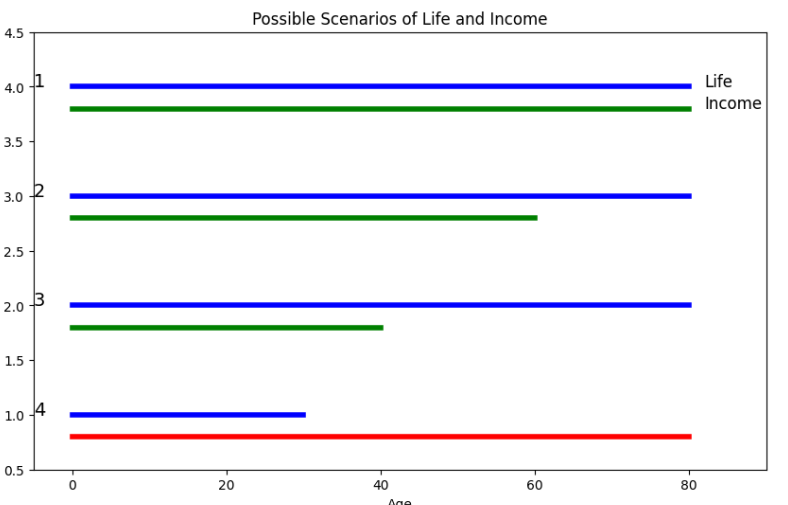
In this scenario, both life and income continue almost till the end of life. A person works, earns, supports the family, and remains financially productive throughout life.
In this scenario, income stops at around 60 years, but life continues until 80 years or more, creating a financial gap.During this period, there is no salary or regular income, but expenses of the earning member and dependents continue. People will need money for food, healthcare, medicines, and regular living expenses. This phase is called retirement life.
In this scenario, income stops early because the earning member dies at age 40, but the life of family members continues.
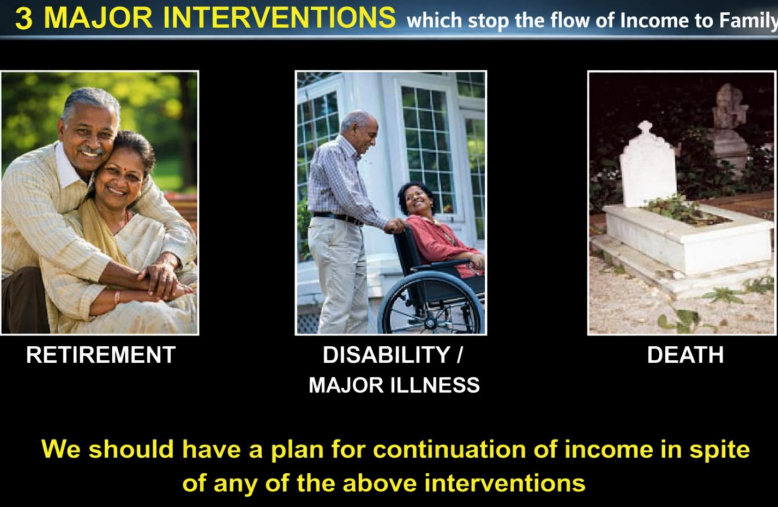
Income stops very early due to death, disability, or critical illness, while the life of the family continues. Here, earning stops at around 30 years of age, but the family may live for another 50 years.
Responsibilities remain such as:
not lose sight of the fundamentals.
Life Insurance Corporation of India, Shillong
+91 9436103276
nayanbhowmicklic@gmail.com
www.keytowealth.org